
The last decade of the 20th century was a mixed bag for me. As I have mentioned before, in
1991, I left SCETV and full time broadcasting, but I remained involved with the Firing Line Debates on PBS. The '90s were transformative for broadcasting.
Broadcast technology changed significantly for radio first. Recorded media changed
from vinyl records to cartridge tapes in the studios and 8-track tapes in the consumer market. Then it changed to cassette tapes, CDs and finally the various audio file formats, WAV and MP3 being the most prominent. Consumer audio is seeing a revitalization of vinyl but the radio broadcast environment, which is now heavily leaning into computer-based automation and content delivered by satellite or internet, is not.
Television tracked a similar path via deregulation, digital video, networks and automation.
Today, many TV stations operate at least part of the day with no one in the station; this
switching from network to commercials to syndicated shows occurs at other stations owned by the same conglomerate.
Computer technology also significantly changed radio and television transmitters, making them more reliable and removing the need for transmitter operators either on site or by
remote control. Most of this happened while my back was turned. I was having fun on the internet as new technology was breaking out.
In early 1993, Freddy Vang, the executive director of the South Carolina Water Resources
Commission told me that we needed to share information with other state and government
agencies on the internet. At the time, this was accomplished through a protocol called Gopher, developed by a team led by Mark P. McCahill at the University of Minnesota in 1991, hence the name. Gopher was a text-based sharing system, combining document hierarchies with collections of services, including Wide Area Information Servers (WAIS), the Archie and Veronica search engines and gateways to other information systems such as File Transfer Protocol (FTP). However, there were no direct links to information, making it somewhat cumbersome to find something specific.
When I went to the Gopher server at the University of Wisconsin to find server software that would run on our Digital Equipment Corporation (DEC) VAX 11/750 computer, I happened across an article about this new development on the internet called the World Wide Web (WWW), which seemed to be much more advanced and user friendly than Gopher. Not
only that, but on that same Gopher server, I found downloadable software for both Gopher and the WWW, so I downloaded both.
Before installing Gopher, I went to see Freddy and told him about the WWW and voiced the
opinion that the WWW would likely supplant Gopher on the internet as a way of sharing information. Freddy was all about technical innovation, so he told me to test the web server
first. In less than four hours, I had installed the web server on our VAX, located and downloaded the first graphic web browser called “Mosaic” to my PC, developed my first simple web page using a text editor, writing the Hypertext Test Markup Language (HTML) code by hand and included a simple image in Graphics Interchange Format (GIF) the only graphic format that Mosaic supported at the time. I installed Mosaic on Freddy’s PC and showed him the page. His next five words changed the direction of my IT career: “Let’s go with the web!”.
At the time, there was a major reorganization of SC state government underway, and the Water Resources Commission, Land Resources Commission and Department of Wildlife were all being merged into the Department of Natural Resources (DNR). I developed a website of about 20 pages describing what DNR was and the services it provided to the public. Freddy presented it to the newly installed DNR board, and they approved the publication of the site. Just a couple of months after Mosaic was released, DNR had one of the first websites, if not the first, in South Carolina state government. We started growing the content on the page that included the output from our Graphic Information Service (GIS) department, headed by Jim Scurry and the Southeast Climate Center, and the State of South Carolina Climate office, headed by David Smith, all of which were housed in the agency. Pretty soon, we were making nearly real-time climate and hydrology information available on the web through automation we wrote using scripts written in Practical Extraction and Reporting Language (PERL). A few months later, the State of South Carolina put up a master web page for state government and the DNR web page was linked under it.
One of the fallouts of the new combined DNR was that the new agency now had two computer managers, the one from Wildlife and the one from the Land Resources Commission. There were two from Water Resources, Jim Scurry from our GIS department and me from the Computer Department. Because Wildlife was the biggest agency of those combining, its board was the majority of the new combined boards, and its computer manager assumed management of all the computer services in the combined agency. The IT Department at Wildlife was totally focused on their mainframe and not focused at all on distributed computing the way the rest of us were. At Water Resources, with Jim and I both in computer management positions, we were really top heavy in our IT departments.
I met with Jim and told him that he understood General IT management while I knew almost
nothing about GIS. I asked him if he felt that he could assume management of both. He said that he could and we went to see Freddy, telling him that our departments should merge and that Jim should be the new manager. Freddy wanted to know what would I do, and I said that it was best for both the department and me if I found something else to do in state government. Begrudgingly, Freddy agreed to that arrangement, telling me that there was no hurry for me to leave.
An hour later, I ran into Ted Lightle, the executive director for the Office of Information
Resources (OIR), part of the State Budget and Control Board in the parking garage at our
building. I asked him to be on the lookout for something for me in state government. He asked me to call Sam Griswold, his deputy director whose department ran the State of South Carolina’s website. I met with Sam the next morning and we took a walk along the east bank of the Congaree River to discuss ideas for the future of the WWW. By the end of the week, OIR had reorganized their newly formed internet department and created a web management section under Sam that included Dr. Bill Schmidt, Shirley McCandles and me as the manager with a sole focus on developing the state’s presence on the WWW. I was the state’s webmaster!
My main focus was to “proselytize” the WWW to other state agencies, as well as county and local governments. To do that, we would build websites on the state’s web server, a UNIX Box in my office, while the owners of the new sites evaluated the use of the web and what roles they would play in this new medium. During the four years, the state’s web page grew from a handful of agencies on that UNIX Box to several dozen sites on their own boxes
across state government.
As an example of what we were doing, one of the agencies was the South Carolina Election
Commission led by Jim Hendricks with Marci Andino as his Deputy Director for Voter Services and IT manager. Marci was forward-thinking and looking for ways to provide more services to the county election offices and the voters of the state. To that end, she was already using OIR’s mainframe computer to manage voter rolls and combine election results from the counties to report state totals to the press and other interested parties. Throughout each election night, the counties would post updated totals to the IBM mainframe, and the Election Commission would report the state totals to the press. Her idea was that we should include those totals on their web page. So, every half hour, the mainframe posted the latest election data over a secure FTP to the web server, and I wrote a PERL script that would read the data and post it to a searchable web page. South Carolina was the first state to do that, and the State Election Commission website was the first to win the “Notable State Document” award from the SC State Library. In addition to contact information for the County Election Commissions, we also created processes by which voters could see the precinct locations for each county in the state, which change quite frequently with population growth and shifts.
In the late 90s, South Carolina initiated a plan to add an internet connection to every public
school and library in the state. OIR’s telephone management division was responsible for the infrastructure, and my staff and I became part of a speaker’s bureau to go out and explain the internet to educators and local governments. We covered the state, meeting with teachers, administrators, elected officials and others. After one meeting, I remember the chairman of one of the town councils saying, “Dang, I’m gonna go have to go buy a computer now!”. The Google search engine had just been rolled out at the time
and I remember demonstrating to a group of teachers at Hand Middle School that searching for “Turtles” could result in links to amphibians or a 60s rock band. I also shared that you had to be careful about URLs, “Whitehouse.com” was an inappropriate site for a school and “Whitehouse.gov” took you to the presidential site.
The state branded the entire presence of state government on the internet as “SCINET”. I will tell you that they did not consult me on the name, which was phonetically the same as SkyNet, the AI network that started the fictional human/cybernetics war in the 1984 Terminator movie series. You can believe we had a laugh or two in the state webmaster meetings.
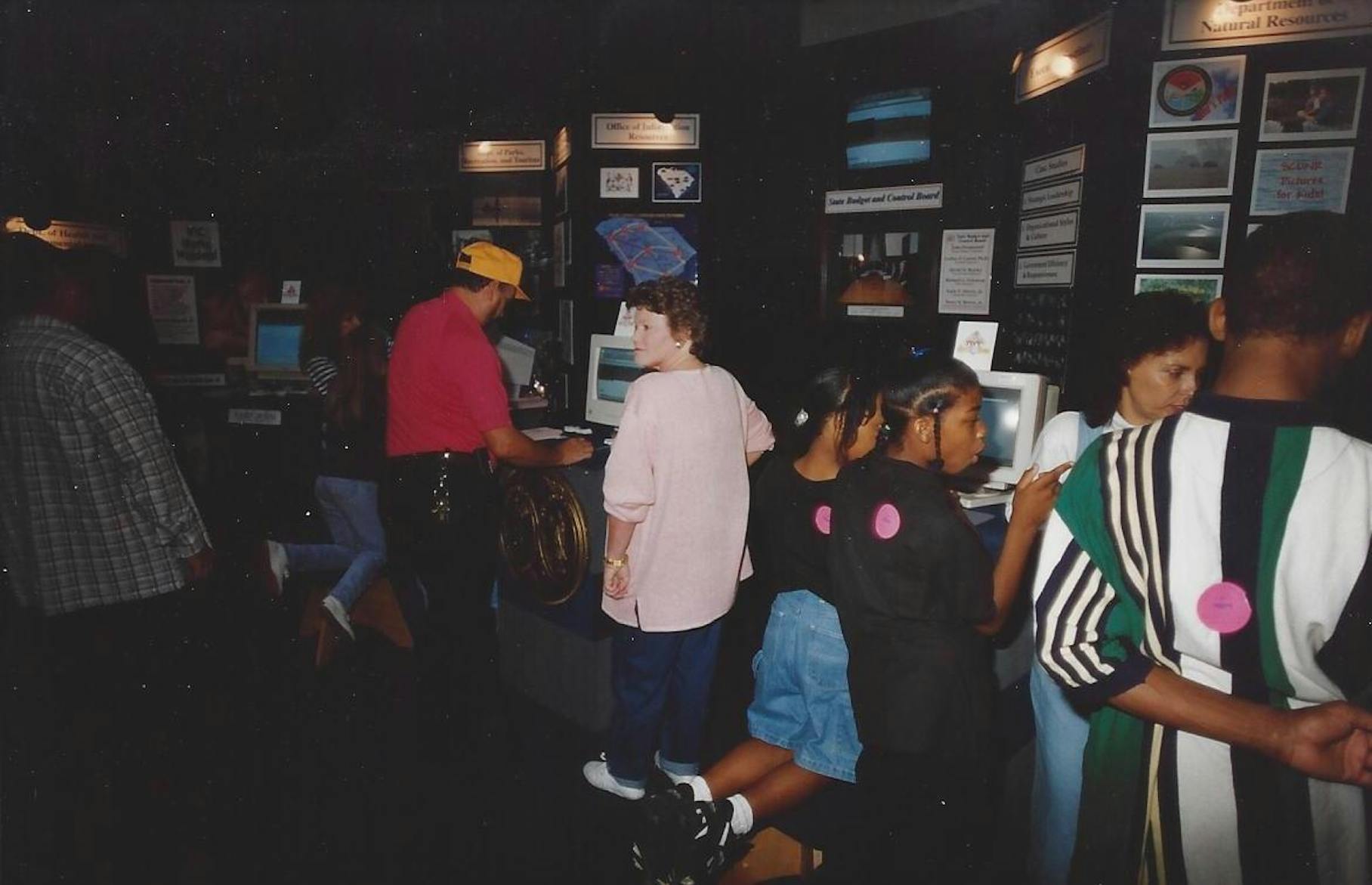
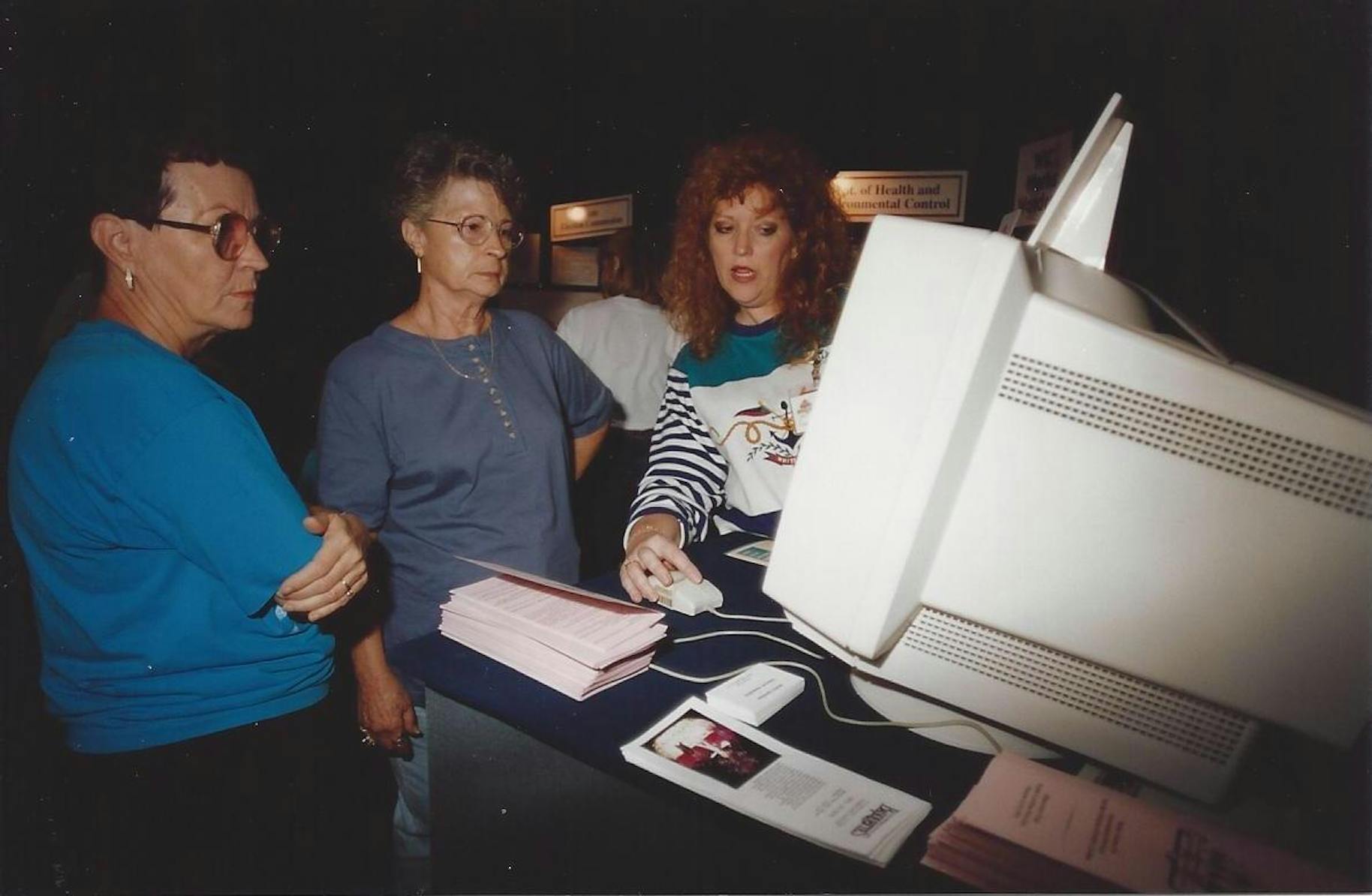
During this time, the OIR initiated an outreach program at the SC State Fair and Chuck Fallaw and I were the co-managers of that initiative. From 1997-1999, I worked daily in that display at the back of the Cantey Building.
A particularly interesting time was December 31, 1999, when everyone was concerned with the Y2K problem and worried that everything was going to blow up. I remember reviewing all the HTML, PERL and SQL code our department had written searching for something that would break as we entered the next millennium. It was all hands-on-deck for us at the data center, well, most of us that is. I was fortunate as I was assigned the responsibility of testing all the web interfaces from my home. All went well. By 1 a.m., I was asleep in bed.
But all was not well in paradise. Ted Lightle, our executive director, was about to retire and the new management team was totally focused on the mainframe environment so the priority of the work on the web was lowered. The writing was on the wall when I received a cold call from an IT recruiter who was looking for someone to be a project manager for web site development for a Fortune 100 Company. On October 1, 2000, I would make the jump to corporate America and start the seven-year stretch when I was not involved in broadcasting.

I was born in a great radio town, Jacksonville, FL. So it was only natural that I joined WUSC (AM at the time) in my first semester in 1963. I went on to a career in commercial radio and television in Columbia, working with WCOS-AM & FM, WIS-TV, WIS Radio, SCETV and PBS. I'm retired now, giving back since 2010 to the station that started my career, WUSC-FM. If you did the math, you would know that I celebrated the 60th anniversary of my first radio show ever in November 2023.